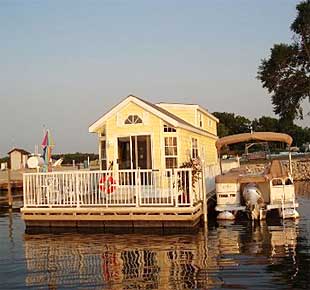
Small Floating Houses
Companies the world over are helping homeowners come to terms
with the facts of flooding on a global scale. Small floating houses
are one way that people can make it through current floods and
plan for the future, when, it seems assured, the water levels
will be higher. This will be especially true in countries that
are already flood-prone, with towns and villages at low levels
or on the sea.
There are worldwide instances of low-lying areas that have always
been susceptible to flooding, and many are seeing even more flooding
than usual. With the population of the world constantly growing,
more people must live near the sea, as well as near inland lakes
and waterways. Balancing the world's need for homes with rising
water levels is a pressing problem, now more than ever.
Floating houses offer homeowners a logical way to deal with the
rising waters in their area. They are quite flexible when flooding
occurs, and can deal with substantial rises in sea level or water
levels. Some homes have also been designed as "amphibious"
houses. They stay on land unless there is flooding, but then are
able to float on the rising waters.
Nice Pipes ...
Both amphibious and floating houses use hollow concrete cubes
at the bases, to give them buoyancy. They have steel pilings that
keep them in the same place, and they can withstand even the strong
types of currents found in open seas. Flexible pipes are used
to bring in electricity and water. These pipes can move and bend
with water swells.
In most situations, floating houses can feel and look like conventional
homes. Attractive exteriors are painted or sided in colorful hues,
giving the smaller houses an almost whimsical look. The residents
won't feel any movement side to side, due to the steel piles holding
the houses in place. They do feel up and down movements, but seasoned
homeowners say that they find that relaxing.
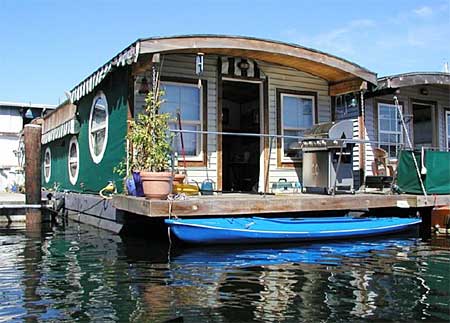 |
The newer models of small floating
houses offer flood protection as well as a high quality
of life and a very low impact on the environment. The design
and technology for these houses has been provided by firms
in various countries, especially Dutch companies, since
the country sees so much flooding.
|
They had severe flooding in 1995, after which residents could
not build beside rivers. Laws like this had to be changed to allow
for floating houses in these locations. Seattle also has their
share of small floating homes.
The philosophy of floating house designers is that water can
either be a threat or a challenge, and a it's a chance to build
better homes. In countries with severe flooding issues, floating
houses are a logical choice to use, in order to move forward.
Getting a Rise Out of It ...
There are other options to building in flood or hurricane-prone
areas. Some houses are designed with nothing on the bottom level
except support. The walls can be opened to allow water to pass
through. But floating houses seem to many to be a better approach,
since no damage is done to the house as it simply rises with the
water.
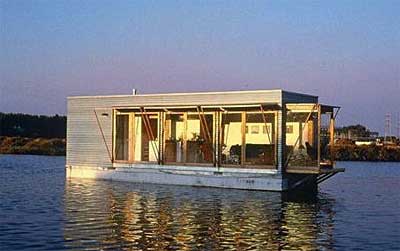
Companies that design and build floating houses are working with
residents of the United States, Europe, Asia and the Far East,
in areas where these houses are the last best hope for homeowners
who live near water.
|